

The recent escalation in trade tensions between the United States and China has placed Indonesia in a challenging position, requiring careful diplomatic navigation. The trade war between the US and China has indeed intensified, with President Donald Trump announcing significant tariff increases on Chinese goods up to 145 percent, while China responded by raising import tariffs on US goods from 84 percent to 125 percent. For Indonesia specifically, the US imposed a 32 percent tariff on certain Indonesian goods.
Indonesia has adopted a balanced approach to the ongoing trade tensions between the United States and China. President Prabowo Subianto has explicitly stated that Indonesia does not intend to take sides in this conflict. During remarks in Antalya, Türkiye on April 11, 2025, President Prabowo emphasized, "We respect all nations. We consider China a good friend, and we also see the United States as a good friend. We want to serve as a bridge."
Trade Projections and Economic Impact
As the United States escalates its trade war against China with punitive tariffs, the global economic tide continues to shift, pushing emerging economies like Indonesia into the center of a complex geopolitical storm.
According to projections from the OEC Tariff Simulator, Indonesia’s export stands to shift significantly from the ongoing decoupling of the US and China.
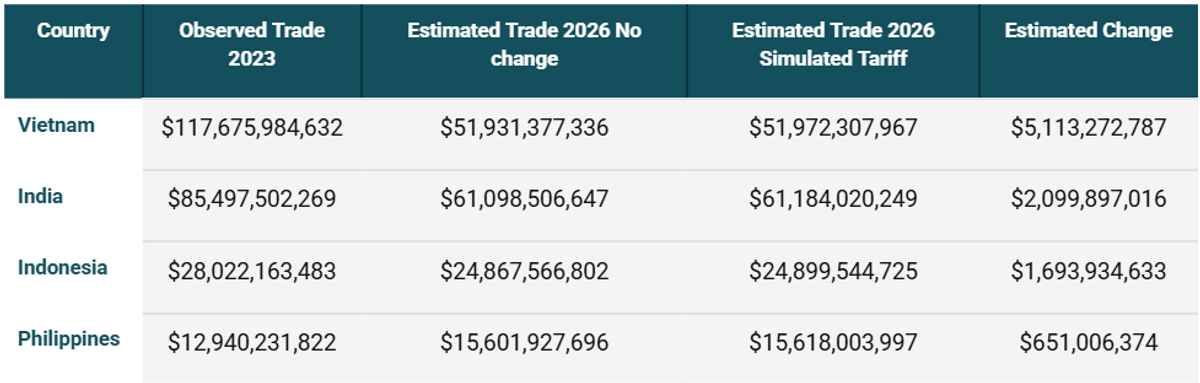
According to the data, Indonesia could see a dramatic increase in its exports to the U.S., in the case that the tariffs on Chinese goods persist or intensify. From an observed export value of $28 billion in 2023, two possible 2026 scenarios have been modeled:
- ●Without any change to current trade policy, Indonesia is projected to export $24.87 billion.
- ●Under simulated tariff conditions on Chinese goods, Indonesia could gain additional export value totalling $24.9 billion
By the end, the estimated gain in exports to the US could surge up to $1.69 billion. Both countries remain an important economic counterpart to Indonesia. According to United Nations COMTRADE database, China remains Indonesia's largest trading partner, with exports to China valued at $64.93 billion in 2023. The US is Indonesia's third-largest export market, with exports valued at $26.3 billion in 2024.
Indonesia's Diplomatic Response
In response to the U.S. administration's 32% tariffs on Indonesian exports announced on April 2, 2025, Indonesia has prioritized diplomatic engagement over retaliatory measures. A high-level delegation led by the Coordinating Minister for Economic Affairs was scheduled to visit Washington D.C. on April 17, 2025, to negotiate and seek mitigation of the imposed tariffs. This delegation aimed to address trade imbalances while maintaining positive bilateral relations.
Indonesia's diplomatic strategy includes concrete economic proposals. The government has announced several trade concessions, including reducing import duties on U.S. products such as steel, mining goods, and health equipment from 5-10% to 0-5%, and lowering tariffs on electronics from 2.5% to 0.5%. Additionally, Indonesia plans to increase imports of U.S. products including liquefied petroleum gas, liquefied natural gas, soybeans, and infrastructure components.
The Ministry of Trade has reaffirmed Indonesia's commitment to maintaining balanced trade relations with all international partners. Director General of International Trade Negotiations, Djatmiko Bris Witjaksono, stated on April 21, 2025, that Indonesia "will continue to adhere to the principles of fair and mutually respectful multilateral trade" and will not take retaliatory action against U.S. tariff policies or pressure from any party.
Conclusion
Indonesia has adopted a pragmatic, diplomatic approach to the US-China trade tensions, seeking to maintain positive relations with both economic powers while protecting its own interests. President Prabowo's stance of neutrality and bridge-building represents a measured response to a complex geopolitical situation. While the trade war presents challenges, Indonesia continues to pursue diplomatic negotiations and explore new market opportunities to sustain its economic growth.